Tuesday, April 30, 2013


Thankful Living is a Sign of Character

None of us have much respect for the person unwilling to take the time to say thanks. Saying “Thank-you” is one of those things in life that separate the sheep and the goats.  Everyone may feel gratitude, but to go to the troubled of expressing that gratitude is a sign of character.  It says something about the kind of person you are.

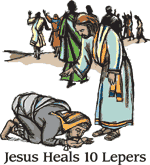
One can only imagine the joy of those lepers in Luke’s Gospel when they were healed by Jesus—jumping, shouting, and praising God.  What a celebration they must have had when they discovered their decaying and disfigured bodies had been made whole.  They must have been delirious with joy.


A man who played the French horn in the Salvation Army band used to say, “When I think of what the Lord has done for me, I could just blow this old horn out straight.”  That is how these ten lepers must have felt.  

For a child of God, thankfulness is not confined to a day or a season, it is an attitude that we should have every minute of every day.  Have you remembered to thank God for: a good night’s sleep, a day of blue sky and sunshine that gets you outside, a day of gray skies and drizzle that keeps you inside, the unexpected voice of a distant friend on the telephone, the comfort of the Psalms, Mozart, Haagen-Dazs, uncontrollable laughter, unashamed tears, your spouse, your children.

The greatest instrument of healing God has ever used in this world only needed to be employed one time.  That single act of healing was the cross.  Our greatest wounds, our most serious infirmities, our most malicious malignancies, were all wiped out by this radical act of spiritual surgery.  Through Jesus’ sacrifice, the destructive power of death was crushed, leaving in its place our choice for health and wholeness.

 
The paraphrase of Psalm 111 goes like this:  “My heart is full today.  I am so grateful for all that God has done for me.  I need but crawl out of my corner of depression and self-pity and look around me to see how great my God is.”
 
Go With God,
Pastor Qualley


Tuesday, April 23, 2013


Living Gratefully is a Sign of Faith

St. Paul advised us to give thanks in all circumstances.  The ability to develop a spirit of gratitude regardless of our situation is a statement that we believe that God is at a work in our universe and that all things work to the good for those who love him.  Such an attitude makes for a joy and a peace that is beyond price.

Charles Spurgeon writes about a weathervane on the roof of a farm building that said, “God is love.”  “Do you think God’s love is as changeable as that weathervane?” asked another farmer.  “You miss the point. It’s on the weathervane because no matter which way the wind is blowing, God is still love.”


There have been times in my life when things were difficult and I felt far too inadequate.  I would turn to my devotional book and would underline things like this, “We have too small a conception of God, of his greatness, of His almighty power, of His wisdom, and of His love.  The Lord is far greater than we can understand.  In the struggle of life there are many things that go against us or make us restless and afraid.  At such times, we turn to Jesus and in His presence we are quieted.”

Praise may easily stop when days are dark and troubles are many.  Do not let that happen.  The most beautiful singers among the birds learn their songs in the night.  If God leads us into darkness, it is only that we may learn the better how to sing.  The songs of praise will make the night light and good.”

We anchor our lives on the promises of scripture, “In this world you will face trials and tribulations, but be of good cheer, I have overcome the world.”  “Peace I leave with you, my peace I give to you, and not as the world gives do I give you peace, so set your troubled hearts at rest.”

Tuesday, April 16, 2013


Living Gratefully

A number of years ago I was having breakfast early in the morning at a neighborhood restaurant.  As the plate of eggs, bacon, and toast were placed in front of me, I bowed my head to say grace.  When I lifted my there stood the waitress. “Something wrong with the eggs?” she asked?  “No,”  I said, “I was just saying grace.”
“Oh, not many people do that around here,” was her reply.
It seems to be human nature to forget to say, “Thank You.”  We all understand and appreciate the importance of gratitude.  In fact, one of the first things we were taught and that we teach our children is to express their gratitude.  When someone gives them something, we ask, “Now what do you say?”  And the child learns from an early age the answer “Thank you.”  And certainly we all know as adults that we appreciate being thanked.  Yet, when it comes to giving thanks to our heavenly father, we often miss the mark.
 
And when it comes to giving out thanks to God, I don’t suppose there is any story in the Bible that is so endearing to us, so timelessly appropriate, as the story of Jesus healing the ten lepers.
Always the master storyteller, Luke wastes not a word as he introduces our story.  “Standing at a distance,” indeed!  That was the plight of everyone certified by the priests as a “leper.”  When the wind was blowing from the leper toward a healthy person, it was prescribed that they must stand 50 years in the distance.  Removed to “reservations” in valleys and gorges outside of the towns, they were kept far from family and friends.  Food was carried and left a safe distance from the colony, a neutral area, to which the members of the colony would then come.  When it was necessary to go into the town, the leper would shout “Unclean! Unclean!  Some carried a little bell.  Its tinkling sound very nearly mimicked the terrible word: “Ding-a-ling! “Unclean”
“Unclean!”  The alienation and loneliness were as pressing a burden as the disease.
In ancient Hebrew tradition, “unclean” was a ceremonial term, not a medical one.  To be a leper was to be “unclean: before God as well.  Though not considered a sin in itself, leprosy was viewed as an act of God.  Priests were required to identify both the curse of the disease and the miracle of its cure.  The book of Deuteronomy gives precise instructions.  Healing was invariably interpreted as a miracle of God.  To be a leper was to live as if under the judgment of God on the one hand and outside the grace of God on the other.

 
No wonder, then, that they cried, “Jesus, Master, have a mercy on us!”  Mercy and grace were the only source of hope for healing the disease, ending the alienation from God, and providing restoration to the fellowship of family and friends.
Luke continues the story: Jesus commands the 10 to go and show themselves to the priests.  Obeying Jesus, they went, and during the journey they were healed.  If ever there were candidates for spontaneous gratitude, they must surely be those 10 newly cleansed people.
It may be assumed that nine continued on their journey to the priests for the verification of the healing.  But one of the 10 overwhelmed by the miracle of grace he had received, momentarily abandons the journey to the priests and returns “praising God with a loud voice,” and “he fell at Jesus’ feet, giving him thanks.”  Luke’s next words add to the impact of the apparent ingratitude of the others.  “Now he was a Samaritan.”
Gratitude is spontaneous.  It cannot be manipulated or cajoled.  It cannot be purchased.

Go With God,
Pastor Qualley

Wednesday, March 20, 2013


Up, Down, All Around
 

Up, down, all around--maybe you’ve experienced this myriad of emotions in life, whether it’s the thrill of victory in a sports game to the next day disappointment at a failing grade, or the excitement and pride of a new job one moment to the discovery of an illness in the family in the next moment. It all can be overwhelming, confusing, even exhilarating, and for others very difficult.

It’s not unlike how we might feel on Palm or Passion Sunday.  Maybe you’ve felt the emotional roller coaster as you have sat and listened to the texts for the day.  How couldn’t you?  Maybe you have recognized it, how the triumphant entry into Jerusalem occurs in the shadow of the cross. 
 
We begin with the upbeat reading of Jesus triumphal entry into Jerusalem when the crowds laid palm branches and shouted, “Hosanna!  Blessed is the one who comes in the name of the Lord!  Hosanna in the highest heaven!”  We then finish Palm/Passion Sunday with Jesus’ arrest, questioning, and crucifixion; we hear the sarcasm and sneering as the soldiers hung the sign above him that read, “The King of the Jews”,” while the people shouted with derision, “Let the Messiah, the King of Israel, come down from the cross now, so that we may see and believe.”
 

Yes, on Palm/Passion Sunday, the beginning of perhaps the most powerful week of the church year, our emotions in essence are being played with.  At one time, the people shouted “Hosanna” and at another time they screamed, “Crucify Him.” 

 It’s not unlike how we are today – up, down, all around. 
 
There are times we show our love to Jesus by shouting “Praise God” or singing “All Glory, Laud, and Honor”; but the next day, when we are at work or school, we essentially say to Jesus, “I don’t need you.  I can do things on my own” or “You don’t matter to me like you did yesterday.”  Indeed, we are a fickle people.
 
How great is God’s love for us in that even though we are up, down, all around, God is not.  God is our constant, our relentless giver of love, and forgiveness.  As we enter upon this Holy Week, may we rely on the persistent, unfailing grace of the one who is our steady, our stronghold in the midst of a constant changing world, and who walks with us through the “ups, downs, and all around.”

 
God’s Peace,
Pastor Percy

Tuesday, March 5, 2013

What Can We Learn On the Road to Emmaus?

Remember in my last writing, I asked you to consider what we can learn from Luke’s Gospel story of Cleopas and his companion along the Emmaus Road. I believe, first, we learn from the story that Emmaus is every person’s town.  We’ve all been there in one way or another, at some time in our lives.  Emmaus is whatever we do or wherever we go to salvage and sort out our feelings, to summon the courage and the desire to keep going on or to try and forget.  Emmaus is whatever we do and wherever we go to reclaim our sanity when our world goes to pieces, when our ideals and dreams are violated and distorted, or when love and goodness are rejected and profaned by selfish persons with almost demonic intent. 


It may happen at the betrayal of one we respect very much, or as the one we love the most with whom we shared the intimacy of marriage leaves us for another person.  It may happen at the death of our spouse, or termination by a long-time employer without explanation; or when an illness confines us and there is no respite from pain; or when illness strikes a child and we’re helpless. We may head for Emmaus when our involvement in the struggle to right some wrong winds up in utter defeat, and the cause to which we gave our life is undermined by the greed and deceit of trusted leaders.  It may come at a personal moral crisis, when we wake up to the fact of how miserable we’ve made our own life or the lives of these who love us. We have to decide whatever we want to change, let go of the old and turn to God and start all over again, pick up and build a new life.  At the turning points and traumas of life, like those disciples of old, we head for some Emmaus, to get away from it all and to wait it out and to seek how to discover to live with it.  Emmaus is every person’s town.


I also think we’ve learned that we have a friend who joins us along the Emmaus Road.  In the midst of, or in the aftermath of defeat and despair, or suffering and pain, of confusion and doubt, there is always the friend who joins us.  That’s what happened to Cleopas and his companion.  They were walking along in dejection and defeat, when all of a sudden they became aware of a third person.


Specifically, there are three things to know about this encounter with “the stranger” who joined these disciples on the Emmaus Road.  One, they didn’t know who he was.  Now what’s important about that?  It is important to know because Jesus often comes to us incognito.  The second thing to note is that this stranger on the road helped them to make sense out of things.  The whole situation seemed to these two men to have no explanation. Third, notice the courtesy of the stranger on the road.  It is captured in the 28-29th verse.  “So they drew near the village to which they were going.  Jesus appeared to be going further, but they constrained him saying, “Stay with us, for it is toward evening and the day is now far spent.” Jesus does not force himself upon us.  He awaited their invitation to come in.  Here is focused for us the greatest and the most perilous gift God has given us—the gift of free will.


What more have we learned from this story? I will leave you with this.  We have to learn how to live in our fourth days—away from the ecstasy and excitement and energy of third day resurrection, and that’s the reason for the Sundays after Easter.  Now our clue for living through all the fourth days is in the way that Jesus was finally known, even on the third day.  In that powerful, simple, straightforward in verses 30-31 when he was at the table with them, he took bread and blessed it and broke it and gave it to them.


Their eyes were opened and they recognized Him.  Look closely at this. Though our understanding of Holy Communion is grounded in this Emmaus meal, as well as the Passover Supper in the Upper Room, which was not a ritual or a special occasion that had been prepared for like the Passover had been.  It was an ordinary meal in an ordinary house at an ordinary time, with an ordinary piece of bread being shared by two ordinary men and Jesus.  So what’s the point?


It is ordinary days that make up most of our lives.  And it is in ordinary ways that the Lord is made known to us. In the breaking of a common piece of bread and the sharing of a cup of wine, the resurrected Lord was known to those crushed and despairing men at Emmaus.  As her did for these men, Jesus will come to us.  When your schedule doesn’t seem to give you even one little break, when you’re involved in your work, with your family, in a those trying ordeals, in depressing circumstances, in dull routines, Jesus will come.
 
Go With God,
Pastor Qualley

Tuesday, February 26, 2013


On The Road Again


Willie Nelson sings it.  I’m sure some of you’ve sung it, too, but not like Willie.  I want you to know  that I don’t live in the world of country music or the world of opera; however, I can recognize that the story line in both is often the same.  It’s the story of love and loss, pain and suffering, shattered dreams and courageous perseverance--life in the raw, life as we experience it.  On the road again is not a happy experience for most of us.  Being on the road is often symbolic of being lost, loneliness, frustration, no-direction, little or no hope.


I don’t know a better image to describe the experience of Cleopas and his companion, in the Gospel story of Luke, than Willie’s refrain, “On the Road Again.”


The Gospel story in Luke is one of the great stores in all of literature.  It tells of two men walking along the Emmaus Road. The waves of heat simmered above the dusty road as they put Jerusalem farther and farther behind them.  As they walked along, they spoke of the events which had taken place in the Holy City. So much had happened in just a few days.  In fact, everything happened so quickly that it all seemed like a terrible dream.

 
There had been Christ’s triumphant entry into the Holy City.  Then, the joy of that moment gave way to fear as a net of intrigue was woven around the Nazarene.  The agony of the crucifixion at Calvary still haunted them.  They had seen the dead, limp body of Jesus removed from the cross and laid in the borrowed tomb of Joseph of Arimathea.  And yet, there were now whisperings and rumors spreading throughout Jerusalem that Jesus was alive.  These were the things that Cleopas and his companion talked about on the road to Emmaus.


The more they talked, the more engrossed they became.  Suddenly, there he was walking with them.  The stranger asks, “What are you talking about to each other?”  Amazed, Cleopas and his companion answer by saying, “You must be the only visitor in Jerusalem who does not know the things that have happened there recently.”  And the stranger asks, “What things?”  And they began to relate the sad events of Jesus. Then he began to discuss Moses and all the prophets and explained to these two men on the Emmaus Road all the scripture that referred to Jesus.


The conversation made the 7.5 mile walk pass quickly. When they reached the city of Emmaus, the sun was sinking fast in the western sky, darkness was approaching and they invited the stranger to spend the night.  When they sat down to eat the evening meal, Cleopas asks the stranger to give the blessing of the meal. There was something in the way he gave thanks.  There was something in the way he took the bread and broke it.  There was something about his gestures that were recognizable.  Perhaps, the folds of his robe fell back and they saw the livid red marks of the nails in his hands. Whatever it was, in that instant, they knew him.  In that moment they recognized him.  In that fraction of a second they knew that their encounter with a stranger had been an encounter with the risen Christ.  And he was gone! It wasn’t possible.  It couldn’t be, but they had seen him with their own eyes and heard him with their own ears.  They got up and ran the 7.5 miles back to Jerusalem to tell the other disciples the incredible news of their encounter with a stranger. 

 
What can we learn from this story?  Until my next blog….


Go With God,

Pastor Qualley

Thursday, February 21, 2013


Listen to Your Life This Lent

“Listen to your life. See it for the fathomless mystery that it is. In the boredom and pain of it, no less than in the excitement and gladness: touch, taste, smell your way to the holy and hidden heart of it because in the last analysis all moments are key moments, and life itself is grace,” wrote writer and theologian, Frederick Buechner in his autobiography Now and Then.

The season of Lent is a journey. It’s a time, if not physically than spiritually, to go for a walk in the wilderness. In the wilderness, there is space to wander and let oneself be in tune with all that comes from God. In the wilderness, we see the hand of God upon all things because it’s time apart from the hurry and rush of life. In the wilderness, there is room to contemplate and examine our paths to which we are called.


Lent is a time of self-examination, of putting on glasses to see clearly our sin and how we stray from God. Lent is a time where we can listen to our life; reflect on our relationship with God; and recognize, as Buechner suggests, that all of life is a gift of God’s grace.

Listening to our lives, journeying with Jesus to the cross, can be troubling and exhilarating both at the same time because the Spirit is moving within us and our sin is laid out before us. But when we reach the cross where Christ takes on our sin, we find that the end of our journey is not really the end. The empty tomb is just the beginning.
 
God's Peace,
Pastor Percy